Somatic therapy in Hong Kong

Faith Lantz · Inside the session

Body-based therapy with Faith Lantz in Central, Hong Kong. Working with the nervous system, chronic tension, and what has been held in the body, sometimes for years. Using craniosacral therapy and Somatic Experiencing together as the session calls for.

Book an in-person session

At a glance

Somatic therapy works with the nervous system and the body directly, not through talking alone.

  • Body and mind are one system, not separate
  • Stress, trauma, and difficult experience are stored physically in the nervous system
  • Sessions work with sensation and the body, not primarily with narrative
  • No diagnosis or prior therapy needed to benefit

Origin & history

Where somatic therapy came from

Somatic therapy has roots going back a century, through several practitioners who each reached the same discovery from different angles: the body knows.

  • Wilhelm Reich

    1897–1957Austrian psychoanalyst and student of Freud, Reich discovered something his contemporaries weren't looking for: his patients' emotional defences showed up as chronic muscle tension. He called it "character armor," the body physically organising itself around psychological protection. He developed vegetotherapy, the first body-based psychotherapy, working directly with breath and muscular tension rather than language alone. His later work became controversial, but the core insight held: the body holds the story.
  • Elsa Gindler

    1885–1961A German movement educator who developed a quiet, attentive practice she called Körperschule (body school, or body awareness). Her insight was simple and radical: when you give the body careful, unhurried attention, it finds its own way. She influenced a generation of practitioners including Charlotte Selver, who brought her work to the US as Sensory Awareness and introduced it to a generation of psychotherapists and movement educators. Gindler's contribution was methodological: the quality of attention itself is therapeutic.
  • Moshe Feldenkrais

    1904–1984Israeli physicist, engineer, and judo practitioner. After a serious knee injury that his doctors said would require surgery, Feldenkrais healed himself through movement and attention, and turned his discovery into a method. The Feldenkrais Method works with the nervous system's plasticity: habitual patterns of movement and holding can be interrupted, and new patterns learned. His key insight was that movement is the language the nervous system uses to organise itself, and that habitual patterns, no matter how entrenched, can change.
  • Alexander Lowen

    1910–2008Trained directly under Wilhelm Reich, Lowen founded Bioenergetics in the 1950s: a body-based approach that linked chronic muscular tension to emotional holding patterns. He developed physical exercises and body postures designed to help those patterns discharge. Lowen gave the field its vocabulary of energy, grounding, and aliveness, and made body-based work available to a much wider clinical audience.
  • Thomas Hanna

    1928–1990Philosopher, movement educator, and student of Feldenkrais, Hanna gave the field its name. In 1976 he coined the term "somatics" (from the Greek soma, meaning the living body) as the title of a journal he founded. His definition has held: somatics is "the body experienced from within." This distinction matters. A body observed from the outside is an object; a body experienced from within is a subject, a knower. Somatic therapy works with the knowing body, not the body-as-machine.
  • The modern convergence

    1990s – PresentBy the 1990s and 2000s, these traditions began integrating with neuroscience. Bessel van der Kolk's decades of neuroimaging research showed that trauma is stored as body memory, not primarily as narrative. Dan Siegel developed interpersonal neurobiology, articulating how body-based approaches build neural integration. The somatic field now has both ancient roots and cutting-edge science on its side.
  • Wilhelm Reich1897 – 1957 · Vienna & New YorkPsychoanalyst · Founder of body psychotherapyFirst to work directly with the body in a psychological context. His concept of character armor (emotional defence as chronic muscular tension) is foundational to every somatic modality that followed.
  • Thomas Hanna1928 – 1990 · San FranciscoPhilosopher · Named the fieldCoined "somatics" in 1976 and gave the field its philosophical ground: the body experienced from within. Without his naming, the disparate traditions might not have recognised themselves as one movement.
  • Elsa Gindler1885 – 1961 · BerlinMovement educator · Pioneer of somatic attentionHer quiet, attentive Körperschule influenced generations of practitioners. The idea that careful attention to the body is itself therapeutic runs through every somatic approach today.

How it works

Body and mind as one system

The body isn't a container for the mind. It is the mind, or more precisely, body and mind are one continuous system. Somatic therapy starts there.

The nervous system is the key. The autonomic nervous system governs our responses to the world: safety, threat, social engagement, shutdown. When it gets stuck in a pattern, symptoms follow: chronic tension, anxiety, insomnia, dissociation, pain that has no clear physical origin. These are not problems of will or thinking. They are patterns held in the body's regulatory systems.

The nervous system doesn't speak in language. It speaks in sensation: the tightening in the chest, the jaw that won't unclench, the back that seizes. This is why talking alone doesn't always shift the pattern. You can understand something completely and still feel it in your body. Somatic therapy addresses the autonomic nervous system directly, through sensation, movement impulse, and body awareness, not primarily through the mind's account of things.

Interoception, the body's internal sense of itself, is the primary channel. Research by A.D. Craig (2002) established that the insular cortex, which processes interoceptive signals, is central to both body awareness and emotional regulation. The more connected we are to internal sensation, the more capacity we have to regulate our own state. Somatic work builds this connection.

The practitioner follows what the body offers, creates the conditions for the nervous system to settle and reorganise, and tracks what changes. The work happens at the level of the nervous system, often quietly, often slowly, always with the body as the guide.

  • Autonomic nervous systemThe part of the nervous system that governs unconscious responses: heart rate, digestion, muscle tension, and arousal level. The autonomic nervous system runs our background state. When it gets stuck, everything else follows.
  • InteroceptionThe body's sense of its own internal state, and the substrate of emotional awareness. Research shows interoceptive capacity is directly linked to emotional regulation. Somatic therapy works largely through developing this sense.
  • Nervous system regulationThe capacity to move fluidly between activation and rest, without getting stuck at either extreme. Many people with chronic stress or trauma history live in a narrow band: either wired and unable to settle, or shut down and unable to access energy. Regulation widens that band.
  • Somatic memoryThe body's storage of experience as physical patterns (muscle tension, postural holding, breath habits), separate from narrative memory. The body remembers things that the mind has moved on from, or that happened before language.
  • Window of toleranceDan Siegel's term for the zone of activation within which the nervous system can process experience without going into overwhelm or shutdown. Somatic work expands this window over time, building greater capacity to meet what arises.
  • Vagal toneA measure of the activity of the vagus nerve, which governs the parasympathetic nervous system's regulation functions. Higher vagal tone is associated with better emotional regulation, social engagement, and recovery from stress. Somatic work consistently improves it.

The science

Thirty years of research

The science behind somatic therapy has grown significantly in the last 30 years. Here's the research that matters most.

  • Bessel van der Kolk, MD · 2014

    The Body Keeps the Score, Viking

    Decades of neuroimaging research at Boston University demonstrating that trauma is stored as body memory, not primarily as narrative. Broca's area (the brain's speech centre) goes offline during trauma recall; the body holds what words cannot reach.
  • Antonio Damasio, MD · 1994

    Descartes' Error, Putnam

    Through patients with precise brain lesions, Damasio demonstrated that body states are the substrate of decision-making and feeling. The mind cannot function well without the body's continuous input. This is the scientific demolition of the mind-body split.
  • A.D. Craig · 2002

    How do you feel? Interoception, Nature Reviews Neuroscience

    Established the insular cortex as the seat of interoceptive awareness, the brain's map of the body's internal state. This helps explain why somatic attention produces real neurological change, not just psychological insight.
  • Röhricht, Papadopoulos & Priebe · 2009

    An exploratory randomised controlled trial of body psychotherapy, Psychotherapy Research

    A randomised controlled trial showing that somatic and body psychotherapy produces significant reductions in depression and chronic stress symptoms compared to control groups. One of the cleaner RCT studies in a field still building its research infrastructure.
  • Dan Siegel, MD · 2010

    Mindsight, Bantam

    Introduced the Window of Tolerance concept and interpersonal neurobiology: how relationship and body-based approaches produce measurable neural integration. Articulates the neurological mechanism by which somatic work produces lasting change, not just relief.

Somatic therapy is a diverse field and studies vary significantly in methodology. The evidence base is strongest where it intersects with trauma neuroscience and interoception research. Broader somatic therapy as a clinical category is still building its research infrastructure, and that's worth saying plainly. The practitioners and researchers listed above represent serious scientific enquiry, not alternative medicine claims.

The spiritual dimension

The body as intelligence

Somatic therapy carries a philosophical premise: the body is not a problem to be managed. It is a system of deep intelligence.

Maurice Merleau-Ponty's Phenomenology of Perception (1945) made the philosophical argument that somatic therapy has lived by in practice: we don't have bodies, we are bodies. Consciousness is always already embodied. There is no observer behind the body looking out at it. This is the intellectual ground of somatic therapy's core claim, and it changes everything about how you approach a person.

Symptoms are not malfunctions. The body that can't relax, the jaw that won't unclench, the sleep that won't come: these are intelligent responses. At some point, a threat posture was the right adaptation. The body learned it, encoded it, carried it forward. The difficulty is that the adaptation has outlasted its original purpose. The nervous system is still protecting against something that passed. Somatic therapy doesn't fight that adaptation. It meets it with curiosity, and creates the conditions for the body to update its map.

"The body experienced from within: this is the soma. Not the body as object, but the body as subject: the knower, the feeler, the agent of its own life."

Thomas Hanna, founder of the field, 1976

Elsa Gindler's core insight was that the body already knows what it needs. The practitioner's role is not to diagnose and fix, but to create enough stillness and safety that the client can hear what their own body is already saying. This is not mystical. It is attentive. It requires the practitioner to get out of the way of their own assumptions about what should happen.

Somatic writing often talks about reconnecting with the body, because it describes something real. For many people, especially those who have survived difficult experiences, the body has felt like an unsafe or painful place to inhabit. Dissociation, the sense of not quite being present in one's own skin, is the nervous system's reasonable response to an overwhelming environment. Somatic therapy offers a slow path of return: not fixing the body, but befriending it. Not forcing a reconnection, but gradually making it safe to be present.

Faith does not separate the spiritual from the somatic. The body's capacity to move toward health when the conditions are right, its tendency toward coherence, toward settling, toward life, is itself a form of knowing. She meets that with reverence. The session is a collaboration between the practitioner's presence and the body's own intelligence.

With Faith

How Faith practises it

Two disciplines, held together. The session follows the body, not the technique.

Training. Faith trained with the Upledger Institute in craniosacral therapy and is completing the three-year professional training with Somatic Experiencing International. These are separate disciplines, different lineages, different vocabularies, but they are deeply complementary in practice.

Integration. In a session, CST and Somatic Experiencing®-informed work move together. Craniosacral therapy provides the quality of deep physical settling, the light, following touch, the body-as-guide: a practice in which the practitioner's hands follow rather than lead. Somatic Experiencing provides the language and framework for what the nervous system is doing: tracking activation, working with pendulation between difficulty and resource, understanding what the body is moving through. The result is not technique-led. It is led by what the body is doing in the moment.

Who she works with. Adults with chronic stress, burnout, anxiety, and chronic tension. People with trauma history, both specific events and the accumulated weight of a difficult life. Mothers postpartum. Babies and infants, using craniosacral therapy as the primary modality for feeding difficulties, colic, birth trauma, and unsettledness. She works with men, women, and children.

Approach. One session at a time. Unhurried. The work does not need to be dramatic to be real. Lasting change tends to look like: sleeping better, the shoulders dropping at the end of the day, the jaw unclenching in traffic, less reactivity, more presence. Not a breakthrough. A steadiness that stays.

Location. Central, Hong Kong. Address confirmed on enquiry.

Credentials. Certified in both Upledger and Biodynamic CST, completing SE training. Central, Hong Kong.

Botanical line drawing of a spine with flowers

What it can help with

What people come for

Somatic therapy works best when the body is part of the picture. Which, one way or another, it always is.

  • Chronic stress and burnoutThe wired-but-tired state: activated, unable to settle, running on the fumes of a nervous system that hasn't rested in years. Somatic work addresses the underlying pattern, not just the surface symptoms.
  • Anxiety and chronic activationThe background hum of a system that won't turn off. Talk therapy can help you understand your anxiety; somatic work helps the body learn that it's safe to put it down.
  • Sleep difficultiesInsomnia and sleep dysregulation often have a nervous system basis: the body stuck in activation at the wrong time of day. Regulation work has a direct effect on sleep quality for many clients.
  • Chronic tensionNeck, jaw, shoulders, lower back: tension held in the same places, year after year. Often there is a pattern underneath the tension, not just a structural cause. Somatic work addresses both.
  • TraumaBoth specific events and accumulated experience. The body holds what the mind has moved on from. Somatic approaches like Somatic Experiencing were developed specifically to work with trauma at the level where it is actually stored.
  • Digestive issues linked to the nervous systemThe gut and the nervous system are in continuous communication via the vagus nerve. Chronic digestive difficulty (IBS, nausea, functional symptoms) often has a strong nervous system component that somatic work can address.
  • Postpartum recoveryThe postpartum period is a profound physiological and nervous system transition. CST and somatic work support recovery, help with the shock of birth, and create space for the nervous system to settle.
  • Infant supportCraniosacral therapy for newborns and babies: feeding difficulties, colic, birth trauma, latching problems, and general unsettledness. Very gentle, responsive to the baby's pace.
  • Chronic pain with no clear physical originPain that persists after injury has healed, or pain with no structural explanation, often has a significant nervous system component. Somatic approaches can help where purely structural treatments have plateaued.
  • Not fully present in your own bodyThe sense of being slightly elsewhere, watching your life rather than living it. Dissociation, disconnection, numbness. Somatic work gradually makes it safer to be present in the body, one degree at a time.
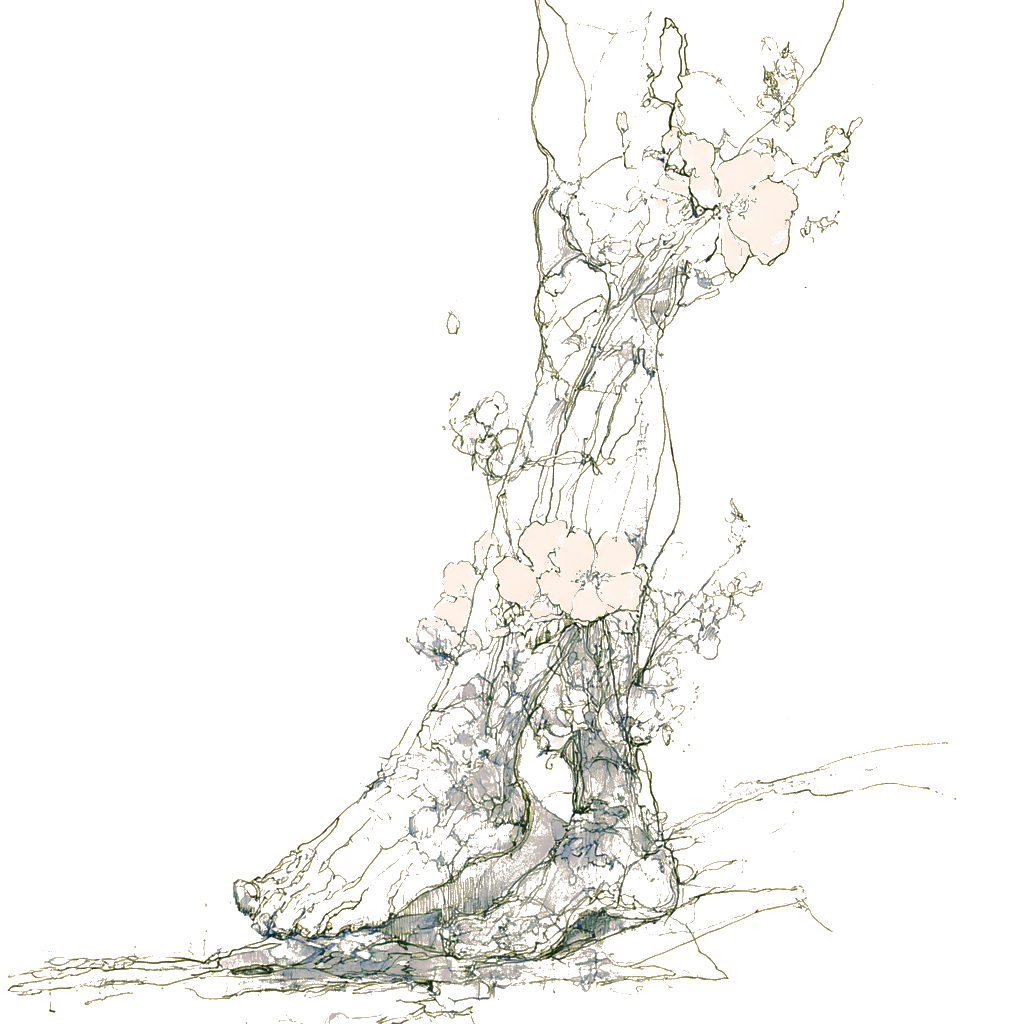
Botanical line drawing of legs with vines
The body holds what thinking cannot reach

What to expect

A session with Faith

No preparation is needed. You don't need to know what your issue is, or how to describe it. You can come exactly as you are.

  1. SettlingYou lie down and rest. There's nothing you need to have figured out beforehand. The session begins with settling, with the transition from the outside world to this room.
  2. Brief conversationWe talk briefly: what brought you here, what's present for you today. There's no need for a full history in the first session. Whatever is most alive is enough to start with.
  3. On the tableYou lie on a treatment table in your own clothes. The contact is very light, and sometimes there is no touch at all. Nothing is forced, and nothing is required of you except to receive.
  4. Following the bodyThe session follows what your body offers: sensations, shifts, movements, moments of stillness, rest. I track what the nervous system is doing and create the conditions for it to reorganise at its own pace.
  5. ClosingWe close with a few minutes of settling and a brief conversation. Whatever you want to name from the session, or nothing at all. Many people find they need a few minutes before returning to the day.

Sessions are 75 minutes in person, 60 minutes online. Change tends to accumulate across a series rather than happening all at once in one session. The nervous system learns gradually, through repetition. Most people notice something shifting within three to five sessions: sleeping better, less reactivity, a physical release in the areas that have been holding. The work deepens over time.

FAQ

Common questions

If something isn't answered here, the simplest thing is to send a message and ask.

No. Talk therapy works primarily through language, narrative, and cognitive understanding. Somatic therapy works primarily with the body: sensation, movement, the nervous system's state in the present moment. Some somatic therapists also talk; the distinction is in what is considered the primary channel of change. In Faith's sessions, there is conversation, but the body's experience is the primary guide.

No. Many people come without a diagnosis, or with a general sense that something in their body or nervous system isn't quite right. You don't need to come with a label or a clear articulation of what's wrong. The body will show what it's working with.

No. Craniosacral therapy uses very light touch, sometimes just a few grams of pressure, at specific points on the body to feel and support the craniosacral system. Somatic Experiencing®-informed work may involve no touch at all, or light contact as part of tracking the nervous system's state. The touch is receptive: following what the body is doing rather than directing it.

Somatic therapy with Faith is largely receptive. You lie on a table, and the session works with what the body is already doing. The change comes from settling and reorganisation rather than effort or practice. Somatic therapy and movement practices work well together, and many people do both.

No. Some people come with a very specific sense of what they're working with; others come with a general feeling of being off, held, or exhausted. The body always knows more than the mind does about what needs attention. What you bring to the session can be as simple as: "I don't know exactly. I just need this."

No. One of the foundational principles of Somatic Experiencing is that the nervous system can heal without full narrative retrieval or re-telling of the story. Faith does not require, or ask for, the account of what happened. The body holds the pattern; the work is with the pattern, not the story. You only revisit what you are ready to revisit.

There is no fixed answer. Most people begin to notice something shifting within three to five sessions. Some people come for a short series around a specific thing; others work with Faith over a longer period. The nervous system learns cumulatively. You are welcome to come for one session and see how it lands before committing to anything.

Yes. Faith works with babies and infants using craniosacral therapy: feeding difficulties, colic, birth trauma, latching problems, and general unsettledness. The work with babies is very gentle and entirely responsive to the baby's pace and signals. She also works with older children. Enquire to discuss what would be most helpful for your child.

Begin when
you're ready.